
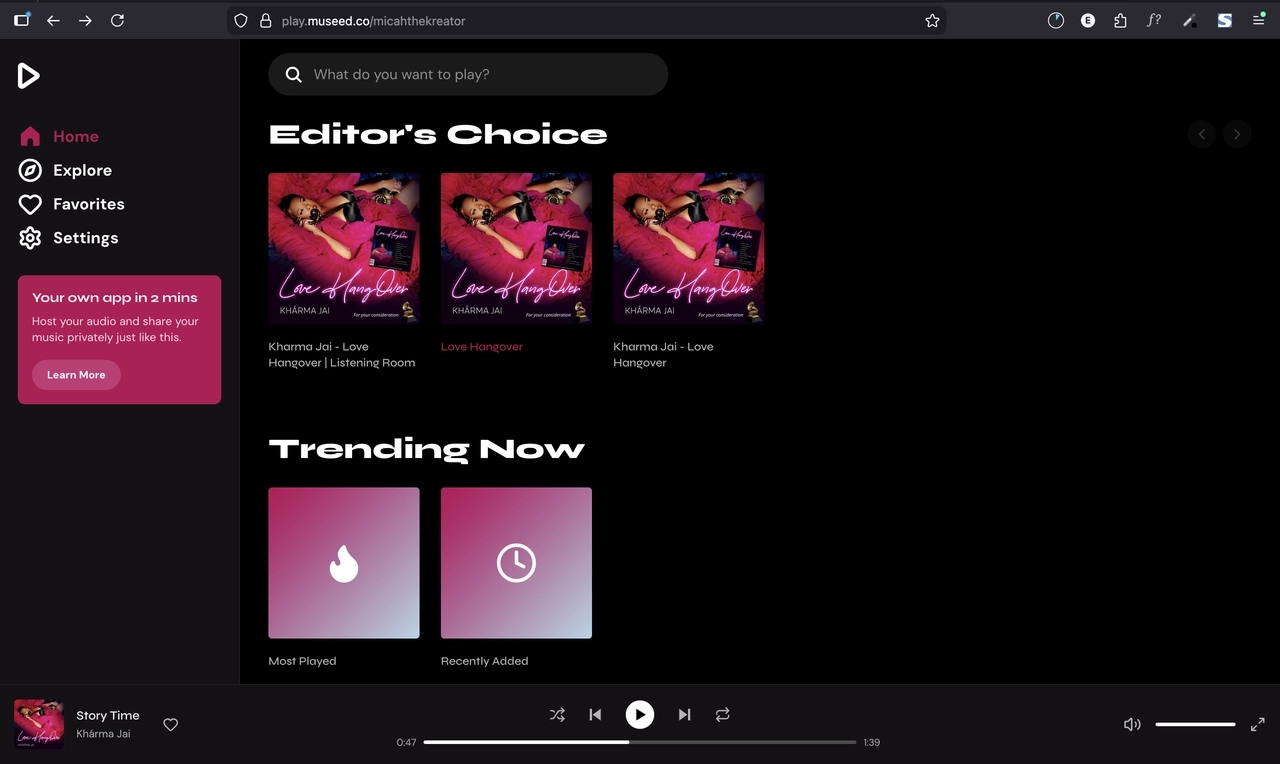
You've poured your soul into your tracks, your meditations, your DJ sets, your exclusive course audio. And then what?
You upload to Spotify and earn fractions of a penny per stream. Or maybe you want to send an album to a label and end up sharing a Google Drive link that makes you look like you're still operating in 2009. Or a sale closes in your store and the buyer gets redirected to a boring page with a zip file download.
Fair question: what are the real alternatives here? Building your own branded streaming platform sounds expensive. But here's what most people don't know yet. In 2026, you can launch a fully branded audio streaming platform with password protection, a custom URL, and your name all over it, in under two minutes. No code. No $50,000 development bill.
Let's break it all down.
The Problem with Sending Fans to Public Platforms
Spotify Pays Fractions of a Penny and Gives You Almost No Data
Let's do the math together.
Spotify pays artists somewhere between $0.003 and $0.005 per stream on average, which works out to roughly $3,000 to $5,000 for every million plays. To earn $1,000, you need somewhere between 200,000 and 333,000 streams.
And it gets worse. Since April 2024, tracks must reach at least 1,000 streams in a 12-month period before generating any royalties at all. According to estimates from United Musicians and Allied Workers, that threshold affected a significant share of tracks on the platform. If you're still building your audience, there is a real chance you are generating streams with no return.
But the money is not even the biggest issue. The bigger problem is ownership.
When a fan discovers you on Spotify, that fan belongs to Spotify, not to you. Spotify does not share listener email addresses with artists. The data you get through Spotify for Artists includes streaming counts, demographics, and playlist performance, but you cannot contact your own fans directly. No email list. No way to reach them outside the platform.
Think about what that means in practice. You build an audience of 10,000 monthly listeners. Spotify changes their algorithm tomorrow and your reach collapses overnight. You have no way to reach those people. No email. No direct channel. Nothing.
And there's another thing worth considering. When you send someone to Spotify to listen to your album, you are sending them to a platform with over 100 million tracks and over 11 million artist profiles. The moment they press play, autoplay kicks in, algorithmic playlists appear in the sidebar, and your carefully curated release competes for attention against literally everything else on the internet. They came to hear you and left listening to someone else. That is not a distribution strategy. That is giving your audience away.
The Google Drive Trap: Amateur Hour
So you try the DIY route. You record an exclusive beat pack, a guided meditation series, or a raw studio session. You charge $30. You send the buyer a Google Drive link via WhatsApp.
Instant perception damage. 🔻
The native Drive audio player is clunky. The URL looks like drive.google.com/file/d/1xKj8.... Anyone who receives that link can forward it to anyone else. There is no branding, no experience, and no way to revoke access if needed.
You charged premium prices and delivered a free-feeling product. That gap destroys trust.
From One-Off Sales to Predictable Recurring Revenue
Here's where things get interesting, and where most creators miss a major opportunity.
The E-commerce Revenue Rollercoaster
If you're currently selling digital audio like beat packs, sound kits, course modules, or exclusive mixes, you probably know this pattern well. Some months are great. Most are terrifying.
You launch something new. Sales spike. Then it dies. You scramble to create the next thing. Launch again. Spike. Silence. Repeat. Every single month starts at zero and you're hoping to match or beat the month before.
Now picture this instead: 500 fans paying you $9 per month for exclusive access to your private streaming platform. That's $4,500 per month in recurring, predictable revenue, regardless of whether you release anything new that week. And recurring revenue compounds over time. It gives your business a valuation. It makes you investable.
When you build your own password-protected streaming platform, you stop selling files. You start selling access.
Want to see what your own audio platform could look like? Try Museed free for 7 days.
The Superfan Subscription Model: Better Than Merch
Artists put enormous effort into merchandise. T-shirts, hoodies, limited posters. The margins are thin, the logistics are painful, and most fans simply do not buy.
But here's what superfans will actually pay for: being closer to you than everyone else.
Your most dedicated fans do not just want your music. They want to feel like insiders. They want to hear the track before it drops publicly. They want the version that will never go on Spotify. They want early access, unreleased cuts, raw sessions straight from the studio.
A private membership platform gives them exactly that. And unlike a t-shirt, there is zero fulfillment cost. You upload a track once. 500 people pay to stream it. 🎯
This is not a new concept. It is the model that Bandcamp superfan programs and Patreon audio tiers have been proving for years. The difference today is that you can do it with a fully branded, beautiful platform of your own, not a workaround built on someone else's infrastructure.
Who Should Build a Custom Audio Platform?
This model works across far more niches than most people expect. If you create, sell, or distribute audio in any form, there is a version of this that applies to you.
🎧 Independent Artists and DJs
You are sitting on unreleased tracks, extended mixes, and early versions that would make your superfans lose their minds. Lock them behind a private membership. Charge monthly. Build a listening experience around your sound on your terms, not inside an algorithm designed to keep people on Spotify.
🎵 Music E-commerce Stores
If you sell sample packs, beat licenses, sound kits, or audio plugins, you know how painful the post-purchase experience can be. A Dropbox link, a clunky download page, a zip file. A branded streaming platform turns your product delivery into a premium experience that justifies higher prices and better reviews.
📻 Internet Radio Stations and Live Audio Brands
Independent radio stations, niche music curators, and live audio brands have audiences that are loyal but scattered across platforms they do not own. A private platform lets you build a real home base: an archive of past shows, exclusive mixes, and subscriber-only content, all under your own name.
🎓 Course Creators and Coaches
You have probably been selling audio courses or meditation packs as one-time downloads. What if instead you built a subscription vault where new content gets added monthly and older modules stay accessible forever, all under your brand? Your buyers become subscribers. Your revenue becomes predictable.
🎙️ Premium Podcasters
Your best episodes should not live on Apple Podcasts for free. A private streaming platform lets you publish bonus content, extended conversations, and exclusive Q&As for paying members only, without depending on a third-party host.
🏷️ Record Labels and Music Entrepreneurs
Managing a catalog? Sending demos to A&Rs? Giving press access to unreleased material? A white-label platform gives you a secure, professional environment instead of a shared Dropbox folder you have no real control over.
🎼 Composers, Sync, and Licensing Professionals
Film composers and sync licensing agents regularly need to share demos and unreleased cues with directors, music supervisors, and producers in a way that looks polished and keeps content protected. A password-protected streaming platform is far more professional than a WeTransfer link, and far more secure.
🕌 Religious Organizations and Community Groups
Churches, temples, and community organizations often produce audio content like sermons, lectures, and cultural programming that they want to share with members only. A branded platform makes that easy, without using a public hosting service that mixes your content with everything else on the internet.
Any of these sound like you? Start your free trial on Museed and have your platform live today.
Why Building a Custom App from Scratch Is a Nightmare
Let's say you decided to build this yourself. Here's what that actually involves.
- $50,000 to $200,000 in development costs at a minimum
- 6 to 18 months of build time before you go live
- Cloud infrastructure to manage, scale, and debug
- iOS and Android app submissions, review cycles, and constant updates
- Audio player bugs, buffering issues, and codec compatibility headaches
- No time left to actually make music
And even the white-label solutions that do exist often have one of two serious problems. Either their branding is plastered across your app, which kills your professional appearance, or their interface looks like something built in 2009. Neither works when you are trying to charge premium prices and look the part.
One thing that often gets overlooked at this stage: once your platform is live, you still need to manage what lives inside it. Organizing your catalog, editing metadata, controlling access per track or collection. That is a different problem from building the platform itself, and it is where most creators hit a wall. We wrote a full breakdown on what an Audio CMS actually does and why generic cloud storage falls short for anyone managing audio at scale.
The Smart Solution: Launch a White-Label Streaming Platform in 2 Minutes
This is where Museed comes in.
Museed is a no-code platform built for creators who want to host, protect, and share audio professionally, without writing a single line of code. It is fully white-label, fully branded, and entirely yours.
Here's how it works.
✅ Step 1: Set Up Your Custom Domain
Your platform starts at yourname.museed.co out of the box. Connect a custom domain and it becomes listen.yourname.com or whatever you choose. The moment someone lands on it, they see your brand, your colors, your logo. It looks like a platform you built from scratch, because in every way that matters, it is.
✅ Step 2: Auto-Organize with ID3 Tags
Upload your audio files and Museed reads the embedded metadata automatically: artist name, album, track title, artwork. It organizes everything into clean, beautiful galleries and playlists without any manual sorting. It just works.
✅ Step 3: Lock It Down with Password Protection
Every piece of content on your platform can be password-protected. You decide who gets access and for how long.
- Create free public tiers with teaser tracks to convert curious visitors into subscribers
- Share a private, time-limited link with press or collaborators
- Revoke access instantly at any time
- Pair Museed with a payment tool like Gumroad: charge for access there, then redirect buyers to your password-protected Museed platform after checkout. Full premium experience, zero friction.
Your audio. Your rules. Your revenue.
Ready to stop sending Google Drive links? Create your Museed platform now, free for 7 days.
The SEO Benefit Nobody Talks About
Here is something most audio creators never consider: where your content lives affects your search rankings.
Audio hosted on Spotify does not contribute to your website's Google ranking. Content on Google Drive is not indexed at all. But when your music or podcast content lives on your own domain with proper metadata, descriptions, and structured content, it contributes directly to your SEO.
A platform at listen.yourname.com is a real, crawlable web property. Your artist name, track descriptions, release notes, and episode summaries can all be indexed by Google. Over time, that compounds into organic traffic bringing people directly to your platform instead of to Spotify's homepage.
Frequently Asked Questions
Do I need to know how to code to set up my own streaming platform? No. Museed is designed for creators, not developers. If you can manage a playlist, you can launch your own platform.
Do I have to choose between my own platform and Spotify? Can I use both? You can absolutely use both at the same time, and many creators do. Distributing music through Spotify or Apple Music via a distributor like DistroKid or CD Baby does not prevent you from hosting content on your own platform as well. A common approach is to use Spotify for public discovery and your own platform for premium or exclusive content. One brings new listeners in. The other is where your most loyal fans pay to go deeper.
Is my audio actually secure on a password-protected platform? Far more secure than a shared Drive or Dropbox link. With password protection and controlled access, you decide who can listen and for how long. You can revoke access at any time, which is simply not possible with a Drive link you have already sent out.
Will my platform work on mobile? Yes. Museed platforms are fully responsive and work on iOS, Android, and desktop without requiring any app store submission.
What is the main difference between Spotify and my own platform, from a business perspective? On Spotify, you earn a small amount per stream and you cannot contact your listeners directly. Your fans are technically Spotify's users, not yours. On your own platform, you capture the relationship. You can collect emails, build a direct communication channel, and create a premium experience your audience pays for directly.
Final Thoughts: Stop Renting, Start Owning
Every stream you send to Spotify is a stream you are giving to someone else's platform. Every Google Drive link is a missed opportunity to build something that reflects the actual value of your work.
You have already done the hard part. You made the music, the course, the content. Now give it a home that matches its value.
A private, branded streaming platform is not just a delivery mechanism. It is a business model.
- Predictable, recurring revenue ✅
- Full control over your audience relationship ✅
- Your own email list, your own data ✅
- A premium experience that justifies premium pricing ✅
- No dependency on algorithms or platform policy changes ✅
The creators who build lasting income in 2026 are not necessarily the ones with the most Spotify streams. Many of them are the ones building direct relationships with their audiences and getting paid for it on their own terms.
Ready to Share Your Audio Professionally in Under 2 Minutes?
Stop sending amateur cloud links. Give your tracks, your courses, and your content the premium home they deserve.
👉 Start Your 7-Day Free Trial on Museed
Your superfans are waiting.